Wednesday, 22 May 2019

May's Interview - Jennifer Rahn


Interview with Jennifer Rahn


Q. Your latest novel,Dark Corridor is set in the same universe as a previous novel of yours, The Cyanide Process. So to begin with, can you tell us about this universe?

The Sphairan Universe consists of several colonies that originated from Earth, and each one is primarily looking out for itself. A given colony tends to have a certain speciality, and many of them were seeded by a unique Earth culture, which has then evolved in the absence of other Earth cultures. Some colonies are planet bound, such as Xuizo, which is a mining colony and predominantly French, Ursalia which is an agricultural colony and predominantly Canadian, whereas Sphaira is an administrative colony and very multicultural. The Sphairan authority over other colonies is variable. Because of the vast distances, regulation and law enforcement can be difficult, and in many cases is managed through private firms. There are also ship bound colonies, such as the Yoshinogari, who have a reputation for being pirates, but have rebranded themselves as a respectable corporation. Sarah’s Cove and Fat Boyo’s Den are pirate coves along the Merry Porto asteroid belt. There are also hidden cities residing in pirate territory, outside of Sphairan influence, and semi-legitimate contractors, such as the Kvinesdal Elite—mercenaries who have unregistered “nests” scattered throughout the space regions. Everything from goods to technology to personnel are traded. A lot of this is impacted by politics and/or containment of disease.


Q. How about introducing us to the protagonist of Dark Corridor – Adynn Sheffield. She’s an interesting character. For our readers, what makes her tick?


Adynn is ultimately looking for family. She desperately wants a home where she can trust everyone has her back, and she will return that loyalty ten-fold. She is done with having family taken away from her by the power-hungry and greedy, and is in no mood to back down from a fight. If she must be the one to stop the entire universe from being run over by bad guys, so be it.


Q. Do your stories have a common theme of females fighting the system or am I reading too much into this?


Hmm. I think maybe I would say females existing on their own terms within the system. I didn’t intend for them to be overtly feminist, and I think the male characters are equally important. My first two novels (fantasy, with Dragon Moon Press) both had male protagonists. The next two (science fiction, with Bundoran Press) have female protagonists, and the one currently kicking around in my head will have an alien and a trans female as leads … I suppose it’s a progression of sorts. What is a common theme for me is having to walk between diverse cultures. Both my parents are immigrants, one from northern Europe and the other south-east Asia, so being a born and bred Canadian myself, there were always three cultures in our household.


Q. You’ve been published in ten anthologies. Quite an achievement. What’s the difference between writing a novel and writing short fiction?


Thanks! I think writing a novel is much easier. The plot arc, character development and expository background don’t have to be crammed into a few paragraphs, all the while avoiding the dreaded “info-dump”. Writing short stories takes some real skill (which I didn’t already have!) However, the benefits are huge. Aside from the (relatively) instant gratification, it’s helped me build discipline as a writer in terms of being economical with word use and writing to spec. Best of all, it’s allowed me to work with a broad range of truly fantastic editors and learn from them. Two notable individuals are Hayden Trenholm and Claude Lalumière.


Q. Of all the short stories you’ve written, do you have a favourite?


Ascension, which appeared in Tesseracts Eighteen: Wrestling With Gods. It features Bobby Fong, a death match fighter trying to escape into Nirvana. He almost makes it…


Q. Some of the anthologies you’ve been published in have been described as ‘very Canadian.’ What’s your take on this?


It’s home. It’s comfortable. It’s a nice starting point. Obviously, I don’t want to be confined by it, but I do like being published with people who are close enough to personally interact with. The Canadian writing community is a lovely group of people to be immersed in.


Q. Do you have a favourite Canadian author?


Currently, Chadwick Ginther. I absolutely devoured Thunder Road. Axel Howerton is a close second. I’m really looking forward to the sequel to Furr.


Q. Okay back to science fiction. Hard science fiction – what is this to you and how is it different from fantasy in your own words?


Being a scientist myself, I would say hard science fiction is fantasy. (Ha!) Half the fun is making stuff up, and I’ve been cautioning my work colleagues who might read my fiction that they are not to tell me if they find mistakes in the science—they can keep that for lab meetings. On a more serious note, I think hard science fiction is fun, because of the “what if” factor, which can be explored and speculated about without having to generate any actual data. All the glory without the slogging. I would say that in comparison to fantasy (at least the stuff I write), it’s more constrained by rules and logic. When I write fantasy, I tend to be more emotional.


Q. Do you research hard science fiction topics?


I do, but not in the same way I would for a science paper. It’s more along the lines of reading a few abstracts and then daydreaming. Part of the science in The Cyanide Process was dreamt up after listening to the first half of a seminar during a cancer research symposium, then letting my mind wander when I was supposed to be paying attention to the second half.


Q. Okay, finally, your writing has been described by some as rather dark in subject matter. Is there another side to you we should be wary of?


Nah. Not anymore. I think I purged most of it when writing The Longevity Thesis. Admittedly, I was frustrated with life when I wrote that. I’ve moved on. Things are pretty awesome now, but that doesn’t mean I’m going to let my characters off any easier!


Glad to hear it! Thanks for the interview and good luck with the book launch. Dark Corridor comes out on May 26th. You can find Jennifer Rahn’s amazon page here, her webpage here and connect with her on goodreads here.


Thursday, 16 May 2019

May's Art by Hue Teo


May's Art by Hue Teo


Cursed Sea


Untitled


Mechs


Near Shore (Monster Concepts)


The Core


Wednesday, 8 May 2019

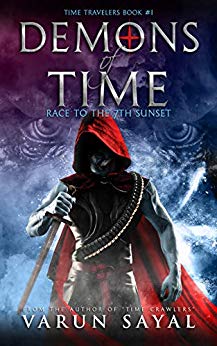
May's Book - Demons of Time by Varun Sayal


This month's featured book is the second novel by Varun Sayal. A lovingly written belter of a book.


A time traveling hero armed with a necromancy spell, travels five thousand years into the future, chasing a demon from his past. His mission was to prevent an apocalypse, but all he cares for is revenge.

3077 BC. Ancient India. A young child Tej and his mother were rescued from the atrocities of Kumbh, a demon of time. Their savior Rigu, a well-known sage, captured Kumbh inside a time-prison. Twenty years later, Tej's scars have healed, but the fire of revenge burns inside him, unabated.
Rigu reveals to Tej that Kumbh has escaped his time-prison and plans to decimate human life on a global scale. Tej has a chance to satiate his thirst for vengeance, but he must travel five thousand years into the future to the year 2024 AD and re-capture the demon. He races against time as he has only seven days, after which Kumbh will be invincible.

A Hindu mythology inspired time travel thriller.


Wednesday, 1 May 2019

May's Story - Reunions by Patrick Walts


Reunions

by Patrick Walts


“I’ll never get used to WETsuits.”

Iskander stopped walking and sat down on a rock. “A technological marvel,” he snorted. “Impervious to compromise, they say.”

Stavros turned, then seized his friend by the wrist. Both men felt a fleeting tingle as their suits touched.

“You want to breathe it, don’t you? The air.”

Iskander was silent.

“Well stop wanting that, right now, do you understand me? Put it out of your head.”

“I know, I know,” huffed Iskander, breaking free from Stavros’ grip. He looked out over the cliff edge. “Still, to fill one’s lungs with the breath of home; to touch the soil with one’s bare hands …”

“Their pathogen detectors are far more sophisticated than you realize.”

Iskander bristled. “Same training under my belt as you, Stavros. In fact, I do believe I scored higher than you in stealth.” He sniffed. “A man can have fantasies –”

“I’m sorry,” cut in Stavros, he too finding a rock to rest upon. “And truth be told, I share them. But we’re on a mission.” He turned. “And there’ll be plenty of time for reflection once that mission is completed and over.”

“If it’s completed,” came the answer from his friend.

Stavros raised a hand to shield his eyes from the sun’s glare, gazed down upon the sea that crashed into the rocky beach at the bottom of the cliff. How it must be teeming with life, he marveled. Sharks, whales, octopuses … it made his blood boil with a lust for adventure, for discovery.

“Don’t think I don’t see you getting all misty-eyed over there, Horatio Hornblower.”

Stavros glanced back at Iskander who was tapping at his ear for emphasis.

“Your heart’s pumping faster too. Maybe this suit’s not so bad, after all.”

Stavros smiled. Fantasies. “All I ask is a tall ship. And a star to steer her by.”

“What?”

“Old earth poem. A very old one. And this …” Stavros paused, gesturing grandly towards the sea. “This was the inspiration behind that and so much other literature. The ocean, the great unknown …”

“Profound,” mimicked Iskander, his eyes following a flock of seagulls passing overhead. “I hope our little visit here is worth starting a war over.”

“Listen,” said Stavros, “the only way there’ll be war is if we get caught. And we’re not going to get caught. You may be seventh level stealth, but I’m no slouch myself, you know.” He stood up and brushed himself off, out of habit, knowing full well that the suit had already analyzed and expelled all foreign particles from his body. “Let’s go find what we came here for. It’s not far.”

They walked and climbed their way over the untamed terrain in relative silence for the next hour until finally, suddenly, Stavros felt the suit readjust.

“Right here.”

He plucked a small tool from his waist and pointed it at the ground. “Cross your fingers,” he said. “Their sensors should read the excavation as normal seismic activity, but if they don’t …”

“Yeah,” said Iskander, “Nice knowing you, too.”

The beam from the device stirred up a tight whirlwind of rocky debris, drilling its way into the Earth.

Iskander stepped forward with a different device in hand. When the beam stopped he waited for the dust to clear, pointing at the perfectly round borehole. A rather large, cube-shaped rock, nearly as tall as an a man of average height emerged from the hole. Iskander carefully guided it away and onto the ground.

They both stared for a good long while, transfixed with wonder.

“Hundreds of thousands of years,” whispered Iskander. “They never found it. I’d give my right arm to crack it open and have a look at what’s inside.”

“Not our place, not our job,” said Stavros. “This, in addition to the data the suits have collected, fulfills our mission, end of. Back to the scout, scoop this thing up and haul outta here. Once we’re past the barricade, there’ll be plenty of time to kick back and relax. Process what we’ve seen,” he breathed. “Until then we’ve got to remain focused. I’m addressing myself, as well.”

Iskander nodded.

“Right, then. Let’s get moving.”

The journey back to the scout was a long one, an urgent sense of anxiety preventing either man from fully appreciating the scenery. The suits were recording it all, though. Every glimpse of every deer darting between every tree, every bird soaring across the clear blue sky, every lizard skittering across every rock, every … bumblebee?

Stavros had never before seen a bee in the flesh, but something about the one presently hovering in front of his face seemed terribly amiss. He zoomed in on the creature’s eyes and swallowed hard. “We’re busted.”

“What?”

More bees followed, and within moments they were surrounded.

“They’re mechanisms,” said Stavros. “Primitive drones made to look like insects, to blend in with the environment. They’re watching us.”

“Why aren’t they doing anything? They’re just … hovering.”

“Confused,” said Stavros. “We look like humans, but we’re not producing carbon dioxide. They aren’t sure what they’re looking at, and are probably running a systems-wide self-diagnostic, trying to determine whether or not their visual receptors are malfunctioning. Perhaps if we –”

Iskander had stuck his arm into the eerily still, silent swarm.

“Kill!”

The bees sizzled, sparked, smoked and spiraled to the ground.

“You idiot!” shouted Stavros, already running full speed towards the scout. “I may’ve been able to reprogram them to ignore us!”

Iskander stubbed his toe as he too broke into a run, but he didn’t slow down; he didn’t dare spare a single second to look back.

By the time they’d made it to the scout, the viewport was completely obscured by a blanket of bees.

“Gonna be trickier getting back through the blockade now that they know we’re here,” said Stavros, placing his hand on the smooth, featureless console.

“Welcome aboard, Captain Stavros,” the computer said cheerfully.

“Shut up. Burn those things off the hull and get us outta here! Arctic entry point 237! Transfer controls to manual, soon as we hit the thermosphere. I wanna be ready for them.”

“Inadvisable,” came the warning, though the computer complied nevertheless.

“If I wanted your opinion, I’d ask for it,” said Stavros. “Go!”

The viewport cleared and the scout shot upwards into the sky.

“You’re not going to get the box?”

Stavros scowled over at Iskander.

“You’re kidding, right?”

“Come on. We’re probably gonna die, anyway. Let’s get what we came for.”

“You mean die because of your itchy trigger finger?” Assuming manual control of the craft, Stavros dived back down to the earth.

“What’s an itchy trigger finger?” muttered Iskander through clenched teeth, his body glued to his seat – his suit, having heard the query, quickly went to work accessing TREE and feeding him a wealth of information about both the etymology of the phrase itself, as well as the primitive projectile weapons that inspired it.

“Clear! This isn’t the time!” Iskander spat, swatting at his face as if there were a sapgnat buzzing around his head.

Stavros, ignoring him, piloted them to the excavation site.

“There!” said Iskander, pointing unnecessarily. “Covered in bees.”

“Drones,” Stavros corrected. “Not real bees. Open cargo doors!”

He activated the collector and brought the box aboard manually: there was a loud clunk that shook the scout as their ‘treasure’ settled into the compartment beneath them.

The drone-bees were beginning to accumulate on the viewport again.

“Buckle up.”

Iskander maintained a firm, white-knuckled grip on his chair, the scout soaring skyward.

“Uh oh,” said Stavros.

Iskander saw them, too – six flaming shapes entering the atmosphere, burning the sky in their wake. They fanned out and soon cooled down enough to be recognizable – Namuu interceptors; automated, likely constructed eons ago, but tactically brilliant and ruthlessly deadly.

Stavros cursed under his breath. “The weapon,” he said.

“The one we weren’t supposed to use under any circumstances?”

Stavros sighed; shrugged. “Let’s start a war.”

Sliding his hand across the panel, he activated the targeting grid on the viewport. He selected all six targets and fired.

Everything – even the plumes of smoke they’d left in their wake – turned into clouds of white vapor, retaining their shapes for just a few moments before momentum dispersed them and they vanished from sight and sensors.

“Nothing left at all,” said Iskander. “Not a single molecule.”

“Yeah,” said Stavros. “Ever hear of Pandora’s Box?”

“No.”

“Well, we just blew the lid off it. They’re gonna wanna know what technology we just hit ’em with; and if they find out the truth, this strained tolerance they practice, allowing us to live independently of the Relocs as our own sovereign world …”

“It all ends,” finished Iskander, unable to say more. He looked over at his friend, knowing full well that Stavros preferred to be kept talking while piloting. Instead he suggested some music.

“Good idea,” said Stavros, entering the troposphere. “Hey. Computer. Play something from one of the 10gen composers.”

“Please specify.”

“… how about some Markus?”

“Eighth or ninth?” came the computerized response.

Stavros snorted. “You kidding? Eighth. And make it something jaunty and upbeat.”

Music began to pour into the cabin as the computer obliged, while at the same time Iskander winced at that weird little twinge he always got in his stomach during the switch to artificial gravity. They were in space.

“Now comes the tricky part. Hang on!”

A shiny metallic sphere was heading towards them at an alarming speed. It suddenly made a full stop, hovering directly in the scout’s path as if it were taunting them, daring them to collide with it.

Stavros maintained course, his fingers dancing across the console like those of a concert pianist, his eyes fixed dead ahead.

“Destroy,” he uttered, and the sphere shattered into hundreds of smaller globes.

“They’re closing in,” said Iskander as the orbs started to glow and spin, surrounding the scout and within seconds they’d joined themselves together in an energy net.

“Got a perfect score on the sim for this,” whispered Stavros. “Piece of cake.”

The scout spun wildly about as Stavros expertly maneuvered her with tight little movements through the rapidly closing net, its flailing blue tendrils caressing the hull like tongues of fire. “Almost there,” he breathed.

Iskander took in the Earth’s moon, reflected perfectly in the pupils of his friend’s eyes.

There was a dramatic swell in the music as they narrowly slipped sideways through a too-close-for-comfort gap in the glowing, burning mesh of blue net. Glancing at the rear monitor, Iskander watched the tiny globes disengage and coalesce back into a larger sphere.

“See? Piece of cake.”

They were approaching Luna.

“You did that on purpose, didn’t you? Timed it to sync with the music.”

Stavros winked. “Now, let me see if I remember where we parked. Gonna fold as soon as we’re aboard Kutan, so be ready.”

“Oh, they’ll love that,” said Iskander. “As if we haven’t already pissed them off enough – now you’re gonna do the thing they hate the most.”

“Don’t see we have much choice. Unless you got any alternatives, Mr. Seventh Level Stealth?”

Iskander said nothing. The large sphere was getting closer.

“Class two Nammu cruiser has entered the solar system. Estimated arrival: five minutes,” said the computer.

“Don’t worry, we’ll be long gone by the time they get here,” answered Stavros as he spotted their ship, nestled against the eastern inner wall of Orlov Y.

“Never been so happy to see that slimy blob of intelligent goop.”

“Don’t talk like that around her,” Stavros called over the strains of the bombastic march now flooding the ship’s cabin.

“Hey,” said Iskander, “I did say it was intelligent.”

They laughed.

“Feeding time, baby girl.”

The ship lit up as it saw them approach, and oozed its way out of the crater like a dog greeting its master. It stretched itself outward like a long, gooey string of melted pizza cheese and reached past the scout to snatch up their pursuer: the sphere became encased within an undulating mass of glowing pink slime, and there was a split-second flash of blinding white light.

Meanwhile the scout plunged into into the ship’s warm, welcoming insides, and the first stages of fold were initiated. The stars around them seemed to blur and stretch as the scout was devoured by Kutan. Iskander screamed as the suits exited their bodies and rejoined the living vessel. He was never going to like traveling naked inside a giant ball of slime. The universe around him bent in half and his brain blinked out for a moment.

Then the familiar words from Stavros:

“Home sweet home.”

Their vision cleared and Galenia came into view.


Reunions is one of a series of interconnected short stories that will eventually comprise an anthology; many of them will be posted as he writes. You can check out more of Patrick’s short stories here, find his blog here, his amazon page here and connect with him on goodreads here.

Monday, 22 April 2019

April's Interview - Susan Kite


Interview with Susan Kite


Q. First of all I’d like to ask about The Mendel Experiment, your rather successful sci-fi trilogy for young readers. A short blurb?


(Maybe not so short, but here goes!)
 
The Mendel Experiment – In the distant future, a galactic federation is desperate for rare resources on a remote planet named Mendel, but the system’s sun is deadly to humans. Scientists create a race of young mutated humans who can survive and work on the planet. They are sent to Mendel with suppressed memories, making survival their only goal.
 
After five years Corree and her small group began having weird dreams. Their hidden memories slowly surface. Corree searches for other mutants and finds that in each place she travels, she mutates to survive in the new environment. When her quest takes her to the desert, Corree discovers Ologrians—aliens that carry her far beyond Mendel’s solar system to their home planet, Alogol.
 
On Alogol, Greelon, an Ologrian scientist, treats her with kindness and teaches her his language and history. He takes her to the Crystal Forest where she finds a gemstone that seems to enhance her abilities. Federation scientists have been trying to destroy the Ologrians. When Alogol’s sun goes critical, Corree joins Ologrian refugees traveling to Mendel. Using her mutant abilities, Corree is able to prevent a Federation battlecruiser from destroying the Ologrians’ ships.
 
Blue Fire – The Federation sends specially adapted robots to compel the mutants to mine the planet’s resources. Corree and her friends work together to not only destroy the robots, but to capture the science station where they were created. They recruit recently created mutants, including Corin, the clone of the scientific genius who created Corree and her friends. Then they take the station into the Mendel system.
 
Power Stone of Alogol – An unknown entity takes control of the orbiting science station, demanding the return of the clone. Corree answers the summons disguised as Corin and travels to the scientist’s starship. She discovers a plan to destroy all non-human species. Alone on an immense battle cruiser, Corree must find a way to stop this destruction.


Q. How did it feel to have the first in the series come second in a literary award?

It felt wonderful! A book is hard work and to get an award like the Royal Palm Literary Award makes the work worthwhile.

Q. Your latest sci-fi/fantasy release Realms of the Cat, involves a cat having to cross over to another dimension to help his ‘alternate’ family. It struck me that you opted for ‘another dimension’ rather than the more traditional ‘other world.’ Do you think than in modern times young readers will relate more to the science based alternate universe idea? (In contrast to the religious undertones of Narnia, the pagan traditions of Harry Potter, etc)

The working title of the book was Portals, so I always saw it as a cross-realm/dimension experience. Also an off-handed way to explain that nine lives myth about cats. And then I threw in the King of the Cats thing. The only thing even remotely religious about most of my stories is that fact that I believe in a basic moral decency in my characters, and that decency will eventually prevail. I also grew up reading huge amounts of science fiction, so that has got to be an influence. As to kids relating, I generally think that kids like a ‘rollicking good tale’ whether it’s couched in some science or all in magic.

Q. How is writing for kids different from writing for adults?

For the most part, I write for young adults even when I am writing for adults. I am not comfortable writing love stories, graphic violence and the like whether it’s sci-fi, fantasy, or anything else. I just finished drafting an adult science fiction, (what in the day would be called a space opera), and I realized that the only difference between it and my young adult sci-fi was that the characters are adults. Any romance is inferred.


Q. I hear you’ve spent many years working in public school libraries. Do you find you’ve been more influenced by the books around you or by the kids themselves?

Mostly the books, because I do love to read. That is one of the biggest things I miss in elementary libraries—discovering the new books that come out and how they affect the kids. When things like Skippyjon Jones, Bad Kitty, Harry Potter, or Percy Jackson fires children’ imaginations, I want to know why. Kids have it tough today; you sometimes see it in their eyes. Books give hope while also giving escape. Maybe that’s another reason I find sci fi and fantasy so fulfilling. You can place hope, heroism, humanity, and courage in a distant setting. You have still touched on those ugly things in life, but it’s not in your face, if that makes sense. I don’t think I could do a credible contemporary novel.


Q. I also hear you’ve been writing for a long time and even have a previous career as fanfiction writer. What can you tell us about your early work?

Up until I got my first (used) computer, everything was in vignettes in my mind while washing clothes or vacuuming the rug. And it was all pretty much fan fiction. I did write some short Star Trek stories in notebooks, even as far as back as high school, but none survived. That’s probably a good thing. Quite simply, after so many years, all those stories in my mind demanded exposure and the internet gave that to me. I also had some ‘mainstream’ stories and novels I began at that time, but I didn’t really know what to do with them, I was still busy raising kids and working full time. I didn’t have time to do more in my spare time than write fan fiction stories. And let’s face it—in fan fiction you have already established characters. It’s easier. I rediscovered Zorro, then tried to do straight sci fi with Lost in Space (hard to do with Dr. Smith in tow), then worked on Buck Rogers in the 25th Century, Voyage to the Bottom of the Sea, and a few other things tossed in. I


Q. Being a writer with experience, do you find it easier to sit down and get right to it; less time just staring at the screen?


Sometimes, but I have found that every stage of life has its own challenges, and retirement from full time work is no exception. I am still getting used to working on a different schedule. There are times when I do stare at the screen; when it is hard to motivate myself and believe me, you can’t force a story. On the other hand, some of my best writing has been in doctor’s office waiting rooms! I always try to keep a notebook with me. I have also tried to challenge myself with short story contests (I have won a few!) and contributions to blogs and newspapers. Another motivator that works for me is the Nanowrimo events. I wrote two novels last year that way.


Q. All your books have great covers by the way. Do you design them yourself?


No. My last four books were done by my publisher. Karen is very talented. I really don’t have good design sense when it comes to that kind of thing. Realms of the Cat went through three incarnations. The publisher had a heck of a time finding the right cat and when she did, I liked the very first design. A local designer friend said it had some things that needed fixing, so I mentioned it to Karen. She made the changes, and again, I said great. Then an artist friend pointed out something else, so I sent another email. The third cover is how is ended up and I think it’s phenomenal. I have had many compliments on it.


Q. Okay, one last question and the chance for a sales pitch. One of your reviews raises the point of how as one gets older, young adult fiction becomes more appealing. Does keeping it simple and focussing on the story and characters make for a better read? Do these books appeal to adults too?


I have had more than one person say the same thing to me. I sure do hope young adult books (mine as well as others), appeal to adults. Of course, I believe that a well written young adult book should also appeal to adults. Many of the themes are universal. These days there are many modern young adult novels that are every bit as complex as your adult suspense thriller. Still, most seem to keep a basic premise. There is a problem or issue that the young person needs to solve.
 
I think the young adult main character is usually not as complicated, as a Stephen King or an Alan Dean Foster character. For instance, look at Harry Potter. He is just a kid trying to survive in his environment and figure out why he is different. (That is a common thread in most kids’ literature. Kids feel awkward even when they have ‘normal’ lives.)
 
Corree, in the Mendel Experiment trilogy, is a fourteen-year-old who starts out dealing with survival—hers and her “family’s.” Despite what the Federation throws at her, her basic goal is survival. Even when she is taken across the galaxy to Alogol, the Federation home planet, or to the renegade battlecruiser, she is still trying to survive, and do it with dignity.
 
Simplicity is more apparent in a Middle grade story. The main characters in Realms of the Cat are cats and dogs (and, of course, Charlie, the crow), who have even less complicated agendas. In this novel, TB has one major objective—to right a wrong, which is saving the little girl who used to be his owner.


Thanks for taking the time on this one Susan. Great answers. And good luck with the new release.


For more information, check out Susan Kite’s amazon page here and her website here . You can also connect with her on goodreads here .


Thursday, 18 April 2019

April's Art by Pascal Blanché


April's Art by Pascal Blanché


Watchtower 21


Foss Station 77


X4


BOT X BOT


Landscape D


Sunday, 14 April 2019

April's Book - Sapience by Alexis Lantgen


This month's featured book is the debut collection from Alexis Lantgen. Ten short stories from an author to watch out for.


What kind of life will we find in the depths of Europa’s oceans? What kind of life will we allow an AI with human level intelligence? The ten stories in Sapience: A Collection of Science Fiction Short Stories explore these questions and many more.

In the near future, humanity builds a colony on Europa, one of the moons of Jupiter. They tunnel into the ice to explore the dark oceans beneath the moon's surface, searching for signs of extraterrestrial life. What they find will change them forever, setting humanity on a path to the stars. But the old conflicts and hatreds of Earth are not so easily escaped. Will human colonists on distant planets and moons create a paradise or a horrifying dystopia?